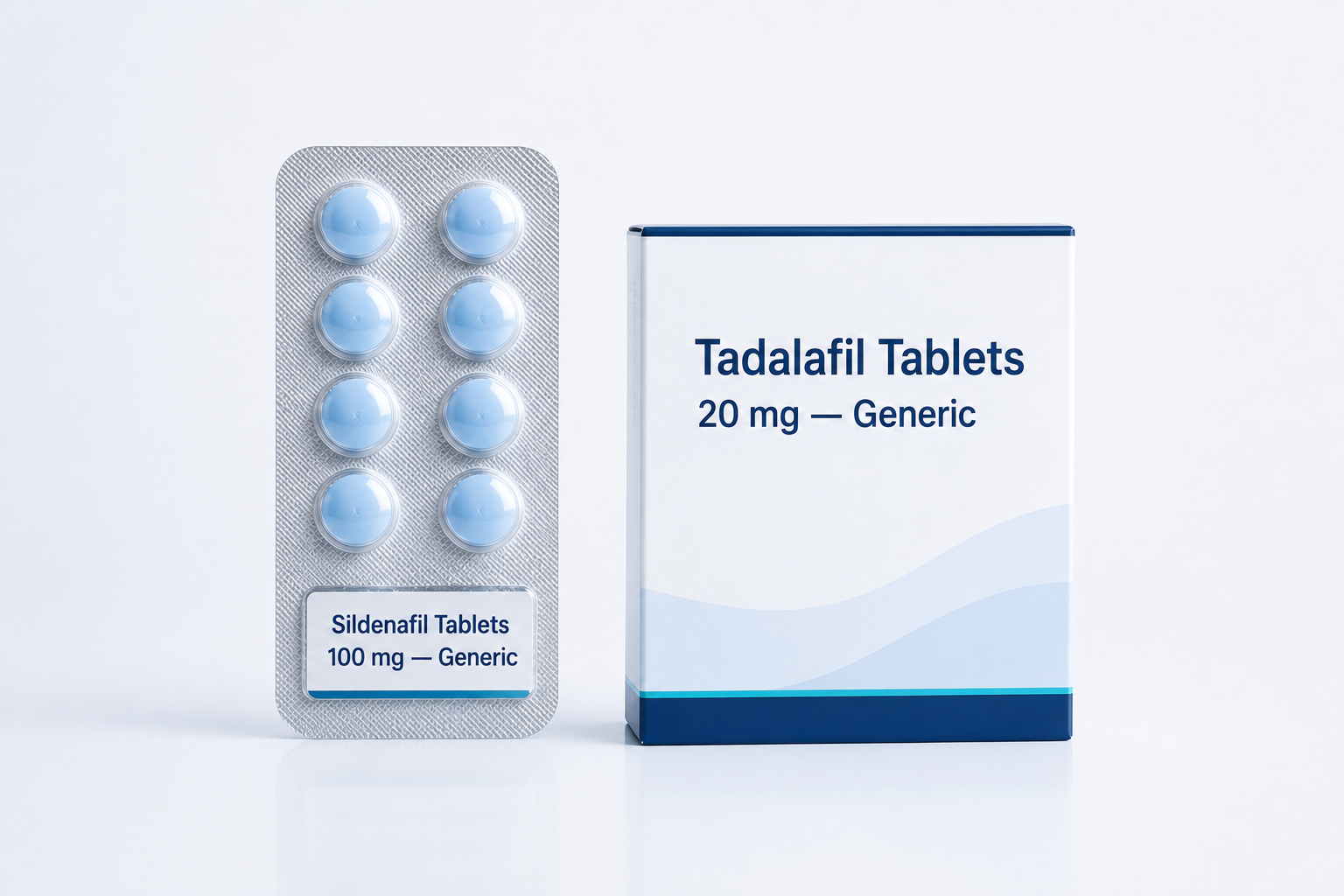
PDE5 Inhibitors • Sildenafil & Tadalafil

Sildenafil vs Tadalafil — Neutral Medical Comparison of Onset, Duration, and Pharmacology

Sildenafil and tadalafil are PDE5 inhibitors used in clinical practice to support the nitric‑oxide–cGMP pathway, the core physiological cascade responsible for smooth muscle relaxation in penile tissue. Although both medications share the same fundamental mechanism, they differ in key pharmacokinetic characteristics. Sildenafil is known for its faster onset, while tadalafil provides a longer duration of action, influenced by its extended half‑life and distinct metabolic profile. Typical dosage ranges vary: sildenafil is available in multiple strengths, including higher milligram formulations, while tadalafil is commonly produced in lower‑milligram tablets. Mechanistic details are explained in Mechanism.

This page offers a structured, Bing‑optimized medical comparison covering onset, duration, effectiveness, side‑effect profiles, food interactions, alcohol interactions, CYP3A4 metabolism, and clinical variability. It is designed for readers seeking a clear, evidence‑based overview without therapeutic recommendations.

What Sildenafil Is

Sildenafil vs Tadalafil

Sildenafil is a well‑established PDE5 inhibitor used in clinical practice to support the nitric‑oxide–cGMP pathway responsible for smooth muscle relaxation in penile tissue. It is formulated in several oral forms, including standard tablets, fast‑dissolving soft tabs, and oral jelly variants designed for rapid absorption. Across these formats, sildenafil maintains predictable pharmacodynamic behavior and remains one of the most widely studied agents in its class. Its long-standing clinical use has contributed to a robust evidence base, making it a reference point for evaluating other PDE5 inhibitors in terms of onset, duration, and overall therapeutic consistency.

The medication is available in a broad dosage range from 25 mg to 200 mg, allowing manufacturers to produce multiple strengths for different clinical contexts. Onset typically occurs within 20–45 minutes, influenced by formulation type and metabolic factors, while duration is shorter compared to tadalafil, reflecting sildenafil’s faster clearance and ~4‑hour half‑life. A general overview of its pharmacology and clinical role is available on the Overview page. Because of its flexible dosing and multiple formulations, sildenafil is widely used in both routine and situational therapy, offering patients a customizable approach to managing erectile dysfunction.

Beyond its primary use, sildenafil is also recognized for its consistent performance across diverse patient groups, including individuals with varying metabolic profiles, age-related vascular changes, and lifestyle factors that may influence responsiveness. Its adaptability and extensive clinical documentation have made it a cornerstone medication in the PDE5 category, shaping treatment guidelines and informing therapeutic strategies worldwide.

What Tadalafil Is

Tadalafil is a long‑acting PDE5 inhibitor known for its extended half‑life and sustained pharmacological activity. Like sildenafil, it supports the nitric‑oxide–cGMP cascade, but its pharmacokinetic profile allows significantly longer duration. Tadalafil is primarily manufactured as oral tablets, which remain the standard form across global markets due to consistent absorption and predictable plasma levels.

Available strengths include 2.5 mg, 5 mg, 10 mg, and 20 mg, reflecting its higher potency per milligram and prolonged effect window. Duration may extend up to 36 hours, influenced by tadalafil’s ~17.5‑hour half‑life and mild PDE11 interaction. This extended activity differentiates it from sildenafil and shapes its timing characteristics. Mechanistic details are discussed on the Mechanism page.

Mechanism Comparison

Sildenafil and tadalafil share the same core mechanism: inhibition of PDE5, the enzyme responsible for degrading cGMP within smooth muscle tissue. By reducing PDE5 activity, both agents enhance the nitric‑oxide–cGMP pathway, supporting vasodilation and improved blood flow. Despite this shared foundation, their pharmacological profiles differ in several clinically relevant ways.

Tadalafil exhibits mild activity on PDE11, a secondary enzyme found in skeletal muscle and other tissues. Although not associated with major clinical effects, this difference contributes to its distinct pharmacokinetic behavior. Tadalafil’s extended half‑life (~17.5 hours) contrasts with sildenafil’s shorter ~4‑hour half‑life, influencing onset, duration, and variability. These factors shape how each medication performs in real‑world timing scenarios and explain why tadalafil maintains prolonged activity while sildenafil acts more rapidly but for a shorter window.

ParameterSildenafilTadalafil
Main targetPDE5PDE5, PDE11
Half‑life~4 hours~17.5 hours
SelectivityHighHigh, mild PDE11

Onset & Duration Comparison

The onset and duration differences between sildenafil and tadalafil stem from their distinct pharmacokinetic profiles. Sildenafil typically acts faster due to quicker absorption and shorter half‑life, producing noticeable effects within 20–45 minutes. Its peak plasma concentration occurs around 2–3 hours, after which activity gradually declines. Formulations such as soft tabs and oral jelly may accelerate onset by improving dissolution and absorption.

Tadalafil, by contrast, has a slower onset of 30–60 minutes but maintains significantly longer duration—often up to 36–48 hours. This extended window is driven by its ~17.5‑hour half‑life and stable metabolic profile. The result is a prolonged effect curve with relatively consistent plasma levels over time. These differences make onset and duration key distinguishing factors between the two medications. More details are available on the Onset & Duration page.

ParameterSildenafilTadalafil
Onset20–45 min30–60 min
DurationUp to 36 hoursUp to 36–48 hours
Peak time2–3 hours~2 hours

Effectiveness Comparison

Sildenafil and tadalafil are both clinically effective PDE5 inhibitors that act through enhancement of the nitric‑oxide–cGMP pathway. Their overall efficacy is comparable in controlled studies, but individual experiences may differ due to timing preferences, metabolic variability, and subjective perception of onset and duration. Many users describe sildenafil as more “immediate,” while tadalafil is often perceived as more “consistent” because of its extended activity window.

Duration plays a major role in how effectiveness is interpreted. Tadalafil’s prolonged half‑life allows a wider time frame of responsiveness, which some users perceive as smoother or less time‑dependent. Sildenafil’s shorter duration may feel more predictable for those who prefer rapid onset and a defined effect window. Dosage ranges also influence subjective outcomes: sildenafil is available in higher milligram strengths (25–200 mg), while tadalafil’s lower‑milligram tablets (2.5–20 mg) reflect its longer pharmacological persistence. Additional information on tolerability is available on the Side Effects page.

Side Effects Comparison

Sildenafil and tadalafil share a similar core side‑effect profile due to their common PDE5 inhibition mechanism. Headache and flushing are among the most frequently reported effects for both medications, reflecting vasodilatory activity. However, each drug also has characteristic differences linked to secondary enzyme interactions and pharmacokinetics.

Tadalafil’s mild activity on PDE11 is associated with a higher likelihood of muscle aches or lower‑back discomfort in some individuals. These effects are generally transient and relate to PDE11 distribution in skeletal muscle tissue. Sildenafil, on the other hand, may occasionally cause visual disturbances such as color perception changes or increased light sensitivity. These effects stem from partial interaction with PDE6, an enzyme present in retinal photoreceptors.

Side EffectSildenafilTadalafil
HeadacheCommonCommon
FlushingCommonCommon
Visual changesPossibleRare
Muscle painRarePossible

Food & Alcohol Interaction Differences

Food and alcohol interactions differ notably between sildenafil and tadalafil. Sildenafil is more sensitive to high‑fat meals, which can delay absorption and reduce peak plasma levels. This effect is particularly noticeable with larger doses or slower‑dissolving tablet forms. As a result, timing relative to meals may influence onset and subjective responsiveness.

Tadalafil is generally less affected by food intake, including high‑fat meals, due to its longer half‑life and steadier absorption profile. Alcohol can influence both medications by enhancing vasodilatory effects, potentially increasing flushing or lightheadedness. Excessive alcohol may also impair physiological responsiveness independently of medication effects. More detailed information on dietary interactions is available on the Food Interactions page, while guidance on safe online sourcing is provided on the Online Safety page.

Pharmacokinetics & Metabolism

The pharmacokinetics of sildenafil and tadalafil differ primarily in how each medication is metabolized through the CYP3A4 pathway. Both agents rely on hepatic metabolism, but their clearance rates and secondary enzyme interactions create distinct timing profiles. Sildenafil undergoes faster biotransformation, leading to a shorter half‑life and a more time‑sensitive effect window. This rapid clearance contributes to its quicker onset and relatively brief duration.

Tadalafil is also metabolized via CYP3A4 but at a slower rate, resulting in a prolonged half‑life of ~17.5 hours. Its mild interaction with PDE11 does not significantly alter metabolism but contributes to its unique pharmacodynamic signature. The slower clearance allows tadalafil to maintain stable plasma levels over an extended period, supporting its well‑known long duration of action. These pharmacokinetic differences explain why tadalafil provides a broader timing window, while sildenafil offers faster responsiveness. Mechanistic details are available on the Mechanism page.

Clinical Use Cases

Sildenafil and tadalafil are used in a variety of clinical contexts, with timing characteristics often shaping user preferences. Situations where rapid onset is important—such as time‑sensitive scenarios or when predictable responsiveness is desired—may align more closely with sildenafil’s faster absorption and shorter half‑life. Its defined effect window can be perceived as suitable for structured timing needs.

Tadalafil’s extended duration supports contexts where flexibility is valued. Its prolonged activity window allows responsiveness across a wider timeframe, which some individuals interpret as more natural or less dependent on precise timing. These differences do not imply superiority; they simply reflect distinct pharmacological profiles. Neutral clinical considerations also include dosage ranges, metabolic variability, and personal timing preferences. Safety‑related information for both medications is available on the Contraindications page.

Sildenafil vs Tadalafil FAQ

Both medications are PDE5 inhibitors, but sildenafil is known for faster onset and a shorter effect window, while tadalafil provides longer duration due to its extended half‑life. Differences also include dosage ranges, secondary enzyme interactions, and timing flexibility.

Yes. Sildenafil typically acts faster because it reaches peak concentration more quickly. Tadalafil has a slightly slower onset but maintains activity for a much longer period, creating different timing profiles.

Yes. Sildenafil’s duration is shorter due to faster clearance, while tadalafil can last up to 36–48 hours because of its long half‑life and stable plasma levels.

Both share common effects like headache and flushing. Sildenafil may cause visual changes due to PDE6 interaction, while tadalafil may cause muscle aches linked to mild PDE11 activity.

Tadalafil has a ~17.5‑hour half‑life and slower CYP3A4 metabolism, allowing it to remain active in the bloodstream far longer than sildenafil.

Sildenafil absorbs more quickly and reaches peak concentration faster, producing a shorter but more rapid onset compared to tadalafil’s slower, steadier profile.

Yes. Sildenafil is more sensitive to high‑fat meals, which may delay absorption. Tadalafil is generally less affected by food, maintaining steadier pharmacokinetics regardless of meal composition.
About Medical Review Policy Editorial Policy Privacy Terms Contact