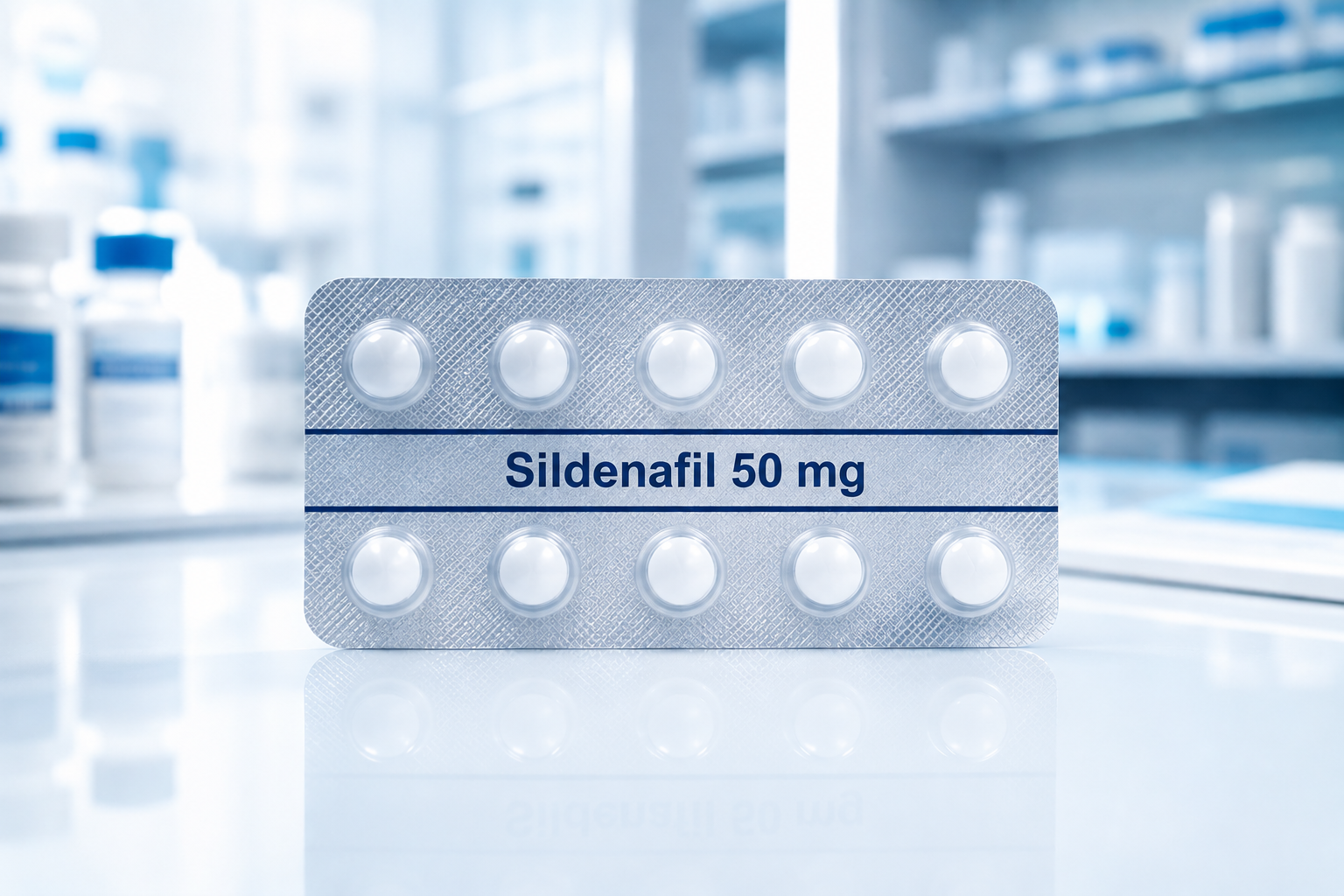
Sildenafil 50 mg is widely recognized as the standard dose used in most clinical scenarios. It provides a balanced level of effectiveness suitable for the majority of adults who require reliable PDE5 inhibition without moving into higher‑intensity dosing. This strength is typically chosen for users who do not respond adequately to 25 mg or who need a more consistent therapeutic window.
At the standard dose, sildenafil enhances nitric‑oxide–mediated vasodilation through moderate PDE5 inhibition, supporting improved erectile response during sexual stimulation. Onset generally occurs within the usual timeframe, and duration remains comparable to other strengths, offering a predictable experience for most users. This page explains how the 50 mg dose works, who benefits from it, and what to expect in terms of absorption, variability, and overall performance.
Sildenafil 50 mg is considered the standard clinical dose for most adults, serving as the baseline strength used in routine prescribing. It offers a balanced therapeutic profile that provides reliable PDE5 inhibition without reaching the intensity associated with higher doses. Because of this equilibrium between effectiveness and tolerability, 50 mg is often selected as the starting point for individuals who require consistent erectile support during sexual activity. The dose is widely used in clinical trials, making it the most researched strength with predictable outcomes across diverse patient groups.
Clinically, the 50 mg dose is recommended for users who did not achieve sufficient response with lower strengths or who present with typical erectile dysfunction patterns without heightened sensitivity. It is also preferred in cases where predictable absorption and stable vascular response are important. As a baseline dose, it allows physicians to evaluate how the patient responds before considering dose adjustments. More foundational information about sildenafil can be found in the Overview. Additionally, the 50 mg strength is often used as a reference point when comparing efficacy across different PDE5 inhibitors, making it a practical benchmark for both clinicians and patients.
Overall, sildenafil 50 mg provides a dependable middle‑ground option, offering enough potency for most users while maintaining a safety profile appropriate for standard clinical use. Its balanced nature makes it suitable for regular use, situational dosing, and long‑term therapy, giving users a consistent and predictable experience without the heightened side‑effect risk associated with stronger formulations.
At the 50 mg strength, sildenafil works through PDE5 inhibition, enhancing nitric‑oxide–mediated vasodilation in penile tissue. This mechanism increases blood flow during sexual stimulation, supporting a stronger and more sustained erectile response. Compared with the 25 mg dose, the standard 50 mg level produces a more pronounced pharmacodynamic effect, resulting in improved vascular relaxation and a more reliable functional outcome for many users.
The stronger effect at 50 mg is linked to its higher degree of PDE5 enzyme blockade, which amplifies the natural signaling pathways involved in erection. This dose is often chosen when a mild response to lower strengths suggests the need for more robust vasodilation. Despite the increased potency, the mechanism remains consistent across doses, differing mainly in intensity rather than in how the drug acts.
For a deeper look at sildenafil’s pharmacological action, visit the Mechanism page.
The onset of sildenafil 50 mg typically occurs within 20–45 minutes, aligning closely with other strengths. Onset is largely determined by absorption rate, which does not significantly change with dosage. This means users can expect a familiar activation window regardless of whether they take 25 mg, 50 mg, or 100 mg.
Duration at the standard dose generally ranges from 30 to 36 hours, offering a stable and predictable therapeutic window. The extended duration reflects sildenafil’s long half‑life and sustained PDE5 inhibition, which remain consistent across doses. While higher strengths may slightly intensify the effect, the overall duration remains stable, making 50 mg a dependable option for users seeking flexibility in timing.
Below is a summary of typical pharmacokinetic parameters. More details are available on the Onset & Duration page.
| Parameter | 50 mg | Notes |
|---|---|---|
| Onset | 20–45 min | Standard absorption |
| Duration | Up to 30–36 hours | Stable window |
| Peak time | 2–3 hours | Same across doses |
Sildenafil 50 mg is effective for a wide range of users, particularly those who require a stronger response than what low‑dose options provide. Its balanced potency makes it suitable for individuals with moderate erectile dysfunction, offering a reliable level of vascular enhancement that supports firm and sustained erections during sexual activity.
The pronounced effect at this dose stems from its higher PDE5 inhibition, which improves blood flow and erectile rigidity more noticeably than 25 mg. Clinical groups that often benefit from 50 mg include adults with typical ED patterns, users who experienced partial response to lower doses, and individuals seeking a stable therapeutic window without escalating to 100 mg.
However, some users may still find the effect insufficient, especially in cases involving severe vascular impairment, metabolic conditions, or significant performance anxiety. In such scenarios, clinicians may consider dose adjustments or alternative therapies. Safety considerations and contraindications are outlined on the Contraindications page.
The 25 mg and 50 mg sildenafil doses differ primarily in intensity of effect, tolerability, and clinical suitability. The 25 mg dose delivers a mild therapeutic response, making it appropriate for sensitive users, older adults, and individuals who prefer a cautious starting point. In contrast, the 50 mg dose provides a moderate effect that is strong enough for most standard clinical cases, offering more consistent erectile support.
Side effects follow the same pattern: 25 mg is associated with low-intensity reactions, while 50 mg may produce moderate vascular-related symptoms such as flushing or mild headache. Despite these differences, onset remains the same across both doses because absorption speed does not depend on strength. Duration, however, is slightly shorter at 25 mg due to lower systemic concentration.
Users who need gentle support or who previously experienced discomfort at higher doses often remain on 25 mg. Those requiring stronger, more reliable performance typically transition to 50 mg. More details on the lower dose are available in the 25 mg section.
| Parameter | 25 mg | 50 mg |
|---|---|---|
| Effect strength | Mild | Moderate |
| Side effects | Low | Moderate |
| Onset | Same | Same |
| Duration | Slightly shorter | Standard |
The difference between sildenafil 50 mg and 100 mg is substantial, primarily in terms of effect strength and side‑effect likelihood. The 50 mg dose provides a moderate, balanced response suitable for most users, while the 100 mg dose delivers a high-intensity effect intended for individuals with more severe erectile dysfunction or those who did not achieve adequate results at lower strengths.
Side effects increase proportionally with dosage. At 50 mg, reactions such as flushing, headache, or nasal congestion are moderate. At 100 mg, these effects become more pronounced due to stronger vasodilation and higher systemic exposure. Onset remains the same across both doses because absorption rate is dose‑independent. Duration is slightly longer at 100 mg, offering an extended therapeutic window.
Clinically, 100 mg may be preferred for users with significant vascular impairment, metabolic conditions affecting responsiveness, or consistently insufficient results at 50 mg. More information on the highest strength is available in the 100 mg section.
| Parameter | 50 mg | 100 mg |
|---|---|---|
| Effect strength | Moderate | High |
| Side effects | Moderate | High |
| Onset | Same | Same |
| Duration | Standard | Up to 36 hours |
Sildenafil 50 mg is associated with a moderate side‑effect profile, reflecting its position as the standard clinical dose. The most common reactions include flushing, mild headache, nasal congestion, and occasional dizziness. These effects occur due to nitric‑oxide–mediated vasodilation, which becomes more pronounced at the 50 mg strength compared with lower doses.
Despite being stronger than 25 mg, the 50 mg dose remains well tolerated for most users. Its vascular impact is noticeable but not excessive, allowing for a balance between therapeutic potency and manageable side effects. This makes it suitable for individuals who require reliable erectile support without escalating to higher intensities.
The moderate side‑effect profile also helps clinicians evaluate tolerance before considering dose adjustments. More information on potential reactions is available in the Side Effects section.
Sildenafil 50 mg is sensitive to food intake, especially high‑fat meals. Fat‑rich dishes slow gastric emptying and reduce absorption speed, which can delay the onset and slightly weaken the overall effect. This sensitivity is more noticeable at the standard dose because 50 mg relies on predictable absorption to deliver its balanced therapeutic response. Users often report slower activation when the medication is taken immediately after heavy meals.
Alcohol also influences sildenafil’s performance. Moderate drinking may reduce erectile response by affecting vascular tone and lowering sexual stimulation, while higher amounts can increase dizziness or flushing due to combined vasodilatory effects. Although 50 mg is generally well tolerated, alcohol can still interfere with consistency and may amplify mild side effects.
Understanding these interactions helps users optimize timing and expectations. More detailed guidance is available on the Food Interactions page, and safety considerations related to alcohol use are covered in Online Safety.
Sildenafil 50 mg is ideal for users with moderate erectile dysfunction symptoms who require a dependable level of support. It is commonly selected when the 25 mg dose does not provide sufficient effect or when users need a more consistent therapeutic window without moving to higher intensities. For many adults, 50 mg offers the right balance between potency and tolerability.
This dose is also suitable for individuals who experienced side effects at 100 mg but still need stronger performance than low‑dose options can provide. Clinically, 50 mg is often recommended for users with typical ED patterns, stable cardiovascular status, and no contraindications that would require dose reduction.
Groups that benefit most include adults seeking predictable onset, users transitioning from lower doses, and those who need moderate PDE5 inhibition without excessive vascular reactions. Safety considerations and medical restrictions are outlined in the Contraindications section.