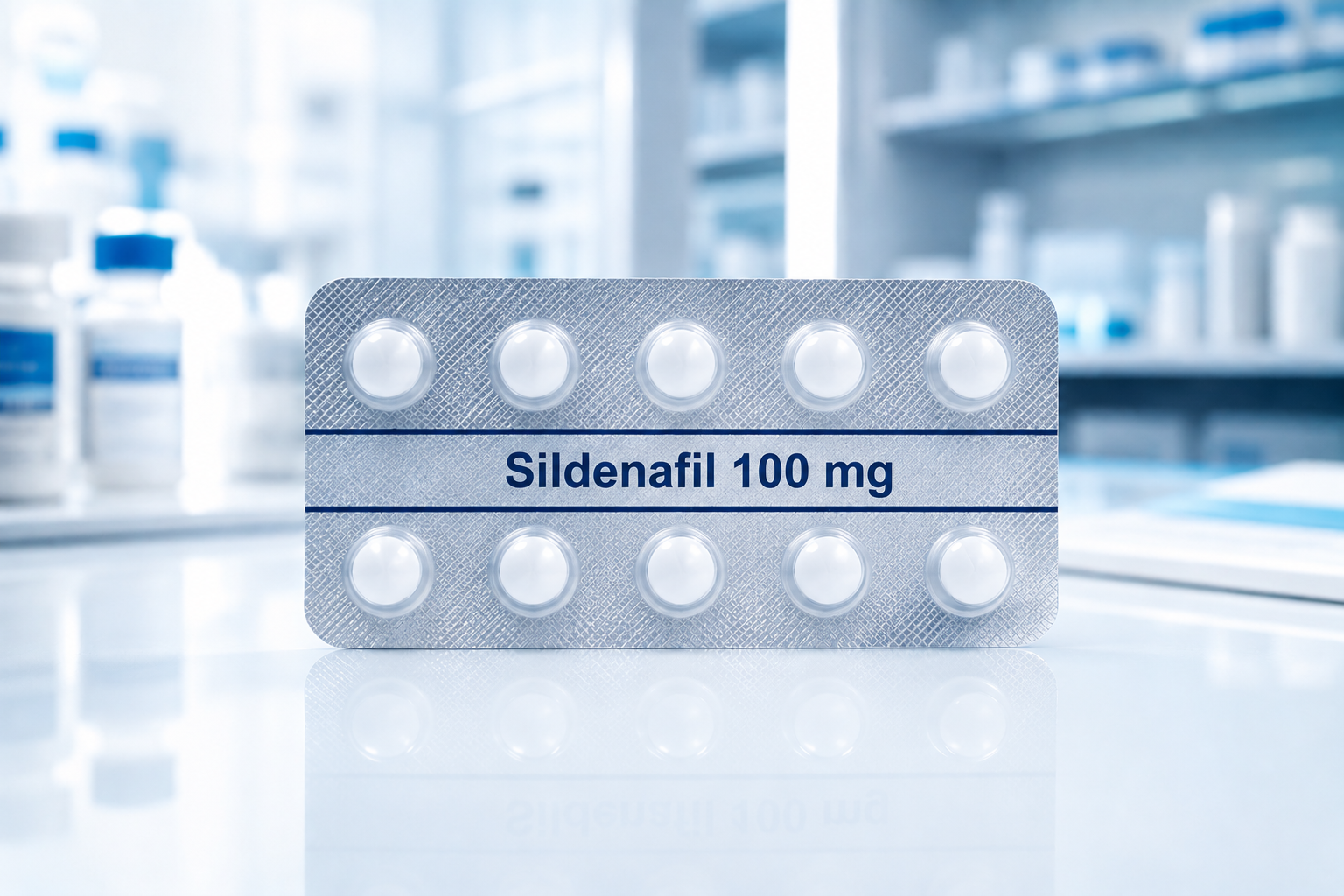
Sildenafil 100 mg is considered a high‑dose formulation used when lower strengths do not provide sufficient response. This dosage is typically selected for individuals who have partial or inconsistent outcomes with standard 50 mg therapy, or for non‑responders who require stronger PDE5 inhibition to achieve adequate erectile function. At the pharmacologic level, high‑dose sildenafil enhances nitric‑oxide–mediated vasodilation more robustly, supporting improved blood flow in cases of reduced sensitivity or higher variability in absorption.
Onset generally occurs within 30–60 minutes, with duration lasting up to 4–6 hours depending on metabolism, food intake, and individual variability. This page provides a detailed overview of effectiveness, safety considerations, dose escalation and reduction strategies, and comparisons with other strengths such as 50 mg. You will also find neutral guidance on interactions, absorption factors, and how 100 mg compares with branded Viagra 100 mg.
Sildenafil 100 mg is classified as a strong, high‑dose formulation designed for individuals who do not achieve sufficient response with standard therapy. While 50 mg is considered the baseline dose for most patients, 100 mg serves as the next therapeutic step when erectile function remains inconsistent or inadequate. Clinicians typically reserve this strength for men with more pronounced vascular insufficiency, reduced PDE5 sensitivity, or higher variability in absorption. This dose is often evaluated in patients whose erectile dysfunction is influenced by metabolic factors, chronic conditions, or long‑term endothelial changes that diminish responsiveness to moderate dosing.
As a high‑dose option, sildenafil 100 mg provides a more robust pharmacologic effect, enhancing nitric‑oxide–mediated vasodilation to support stronger and more reliable erectile responses. It is commonly used in cases where lifestyle factors, comorbidities, or age‑related changes reduce responsiveness to lower doses. The increased intensity of PDE5 inhibition helps compensate for reduced vascular elasticity or impaired blood‑flow dynamics, making the 100 mg strength a practical escalation point in therapeutic planning. A broader overview of sildenafil dosing principles is available on the Overview page.
Because of its potency, sildenafil 100 mg is frequently discussed in clinical guidelines as the upper end of routine dosing, offering a balance between enhanced effectiveness and manageable tolerability. It is also the dose most commonly referenced in comparative studies evaluating treatment outcomes across different patient demographics. For many users, this strength represents the threshold at which erectile performance becomes consistently reliable, especially when lower doses fail to produce adequate rigidity or duration.
At the 100 mg strength, sildenafil produces a significantly stronger PDE5 inhibition compared with the standard 50 mg dose. The higher concentration increases the degree of enzyme blockade, allowing cyclic GMP levels to rise more effectively during sexual stimulation. This amplified biochemical response results in more pronounced smooth‑muscle relaxation and improved penile blood flow.
The enhanced vascular reaction at 100 mg is particularly beneficial for men with diminished endothelial function or those whose baseline nitric‑oxide signaling is weaker. Because the mechanism is dose‑dependent, the high‑dose formulation delivers a more substantial physiologic effect, improving erection firmness and consistency. More details on sildenafil’s pharmacologic action can be found on the Mechanism page.
The onset of sildenafil 100 mg typically occurs within 20–45 minutes, similar to lower strengths. Onset is primarily determined by absorption rate, gastric emptying, and food intake rather than the dose itself, which is why increasing the strength does not accelerate the initial effect. Most users experience predictable activation within the standard window regardless of dose.
Duration, however, may be slightly longer at 100 mg. While sildenafil’s pharmacokinetics remain consistent across strengths, the higher concentration can extend the functional window for some individuals, supporting responsiveness for up to 36 hours. Peak activity still occurs around the 2–3 hour mark, reflecting stable metabolic patterns. A detailed breakdown is available on the Onset & Duration page.
| Parameter | 100 mg | Notes |
|---|---|---|
| Onset | 20–45 min | Standard absorption |
| Duration | Up to 36 hours | Longer window |
| Peak time | 2–3 hours | Same across doses |
Sildenafil 100 mg is most effective for individuals who require a stronger therapeutic response due to vascular insufficiency, metabolic factors, or reduced sensitivity to PDE5 inhibition. The dose is often optimal for men who achieve partial erections with 50 mg but need more consistent firmness and durability. Its enhanced effect makes it suitable for clinical groups with moderate to severe erectile dysfunction.
The pronounced efficacy of 100 mg stems from its ability to sustain higher levels of cyclic GMP, supporting improved erectile quality throughout the dosing window. However, some users may still experience insufficient response due to underlying medical conditions, medication interactions, or lifestyle factors. In such cases, further evaluation is recommended. Safety considerations and contraindications are outlined on the Contraindications page.
Sildenafil 50 mg is considered the standard starting dose for most individuals, offering moderate effectiveness with a balanced safety profile. In contrast, sildenafil 100 mg delivers a significantly stronger therapeutic effect, making it suitable for users who experience partial or inconsistent results at the lower strength. The difference in efficacy is primarily due to the higher degree of PDE5 inhibition achieved at 100 mg, which supports more robust smooth‑muscle relaxation and improved penile blood flow during sexual stimulation.
Side effects tend to be more pronounced at 100 mg because the stronger vascular response increases sensitivity to common reactions such as flushing, headache, and nasal congestion. However, onset remains the same for both doses, as absorption speed is not dose‑dependent. Duration is also similar, though some users may experience a slightly longer functional window at 100 mg. The 50 mg dose is ideal for men with mild to moderate ED, while 100 mg is typically chosen for those requiring a stronger response. More details on the lower strength are available on the 50 mg page.
| Parameter | 50 mg | 100 mg |
|---|---|---|
| Effect strength | Moderate | High |
| Side effects | Moderate | High |
| Onset | Same | Same |
| Duration | Up to 36 hours | Up to 36 hours |
Sildenafil 100 mg is widely regarded as the highest standard dose used in routine clinical practice. It provides a strong therapeutic effect suitable for most men with moderate to severe erectile dysfunction. Sildenafil 200 mg, however, is an off‑label, very high‑dose option considered only in select cases where users show minimal response to 100 mg and have been evaluated for underlying causes of reduced sensitivity. The difference in effect strength between the two doses is substantial, with 200 mg producing a markedly stronger vascular response.
Side effects increase significantly at 200 mg due to amplified vasodilation, making this dose appropriate only for carefully selected individuals under medical supervision. Clinical groups that may consider 200 mg include men with severe endothelial dysfunction or those who have not responded to standard escalation strategies. Duration may extend up to 48 hours at 200 mg, though onset remains unchanged. More information on this high‑dose option is available on the 200 mg page.
| Parameter | 100 mg | 200 mg |
|---|---|---|
| Effect strength | High | Very high |
| Side effects | High | Very high |
| Onset | Same | Same |
| Duration | Up to 36 hours | Up to 48 hours |
At the 100 mg strength, sildenafil commonly produces side effects such as headache, facial flushing, nasal congestion, dizziness, and visual changes. These reactions occur more frequently and may be more intense compared with lower doses, primarily because the stronger PDE5 inhibition amplifies nitric‑oxide– mediated vasodilation throughout the body. As vascular smooth‑muscle relaxation increases, systemic effects become more noticeable.
The high‑dose formulation is therefore associated with a more pronounced physiologic response, which explains why sensitive users may experience stronger reactions. While most side effects remain mild to moderate, they can be more persistent at 100 mg, especially in individuals with underlying cardiovascular or metabolic factors. A detailed overview of all potential reactions is available on the Side Effects page.
High‑dose sildenafil (100 mg) is more sensitive to food intake, especially meals rich in fat. Fatty dishes slow gastric emptying and reduce the speed of absorption, which can delay onset and weaken the initial response. Because the 100 mg dose relies on predictable absorption to deliver its stronger therapeutic effect, heavy meals can noticeably shift activation time and reduce consistency. Users often report slower or less pronounced results when the medication is taken immediately after high‑fat foods.
Alcohol also affects sildenafil’s performance. Moderate drinking may reduce erectile response by influencing vascular tone and lowering sexual stimulation, while higher amounts can amplify dizziness, flushing, or blood‑pressure changes due to combined vasodilatory effects. The stronger vascular reaction at 100 mg makes the dose more sensitive to alcohol‑related variability. More detailed guidance is available on the Food Interactions page, and safety considerations related to alcohol use are covered in Online Safety.
Sildenafil 100 mg is typically selected by individuals with more pronounced erectile dysfunction symptoms who require a stronger therapeutic response than the standard 50 mg dose can provide. It is well suited for users who achieve partial erections or inconsistent results at lower strengths, as well as those whose vascular or metabolic factors reduce sensitivity to PDE5 inhibition. Clinically, 100 mg is often considered the optimal dose for men with moderate to severe ED who need reliable firmness and durability.
This dose is also appropriate for groups with diminished endothelial function or age‑related changes that limit responsiveness. However, sildenafil 100 mg is not suitable for everyone. Individuals with certain cardiovascular conditions, medication interactions, or sensitivity to vasodilatory effects may require lower doses or alternative therapies. Safety considerations and medical restrictions are outlined in the Contraindications section.