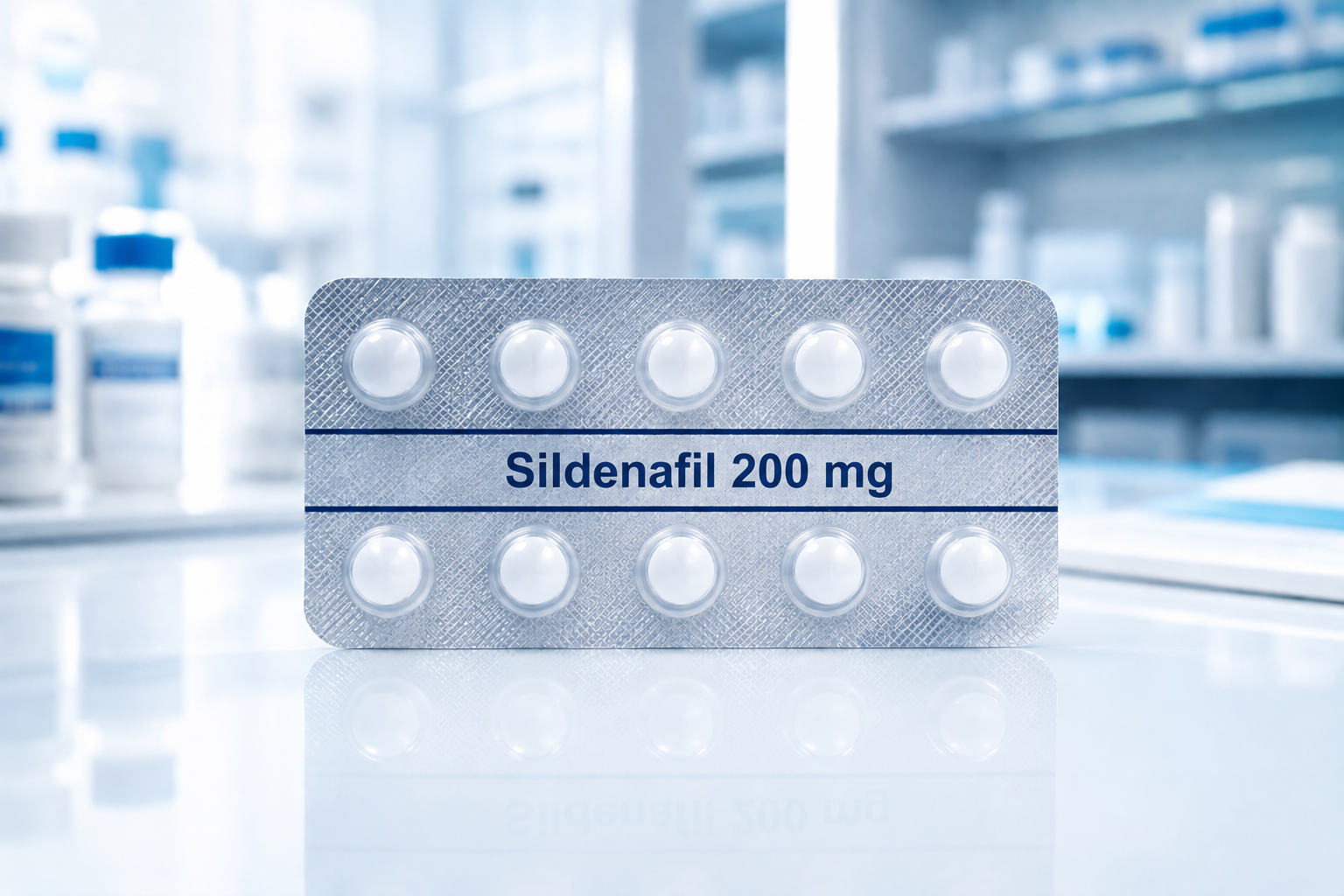
Sildenafil 200 mg is the maximum available dosage and is considered a very high‑strength option reserved for individuals who do not achieve sufficient results with standard doses. It works through intensified PDE5 inhibition, increasing blood flow to penile tissue while maintaining the same core mechanism of action — only the vascular response becomes significantly stronger at this level.
Onset generally remains within 20–45 minutes, and duration may extend due to higher systemic exposure. Because 200 mg produces a more pronounced pharmacological effect, it carries elevated risks, including stronger side effects and greater sensitivity to food or alcohol. This dose should be used only in carefully selected cases where lower strengths have proven insufficient. For comparison, see 100 mg.
Sildenafil 200 mg represents the maximum dosage strength used in clinical practice and is classified as a very high dose due to its significantly intensified pharmacological impact. This strength is not part of standard first-line therapy and is typically considered only for individuals who do not achieve adequate response with lower doses such as 50 mg or 100 mg. In these cases, clinicians may evaluate whether a high-dose escalation is appropriate based on symptom severity, prior treatment outcomes, and overall tolerance. The 200 mg strength is often discussed in contexts where erectile dysfunction is influenced by long-term vascular changes, metabolic disorders, or reduced endothelial responsiveness that limits the effectiveness of conventional dosing.
As a very high dose, 200 mg demonstrates distinct clinical characteristics: stronger vascular response, increased systemic exposure, and higher variability in absorption. Because of these factors, it is reserved for specific patient groups where conventional strengths have proven insufficient. Its use requires careful assessment of risks, comorbidities, and potential interactions. The elevated intensity of PDE5 inhibition at this level may amplify both desired effects and adverse reactions, making clinical monitoring especially important. For a broader overview of sildenafil therapy, visit the Overview page. In practice, this dose is often considered the upper boundary of therapeutic escalation before evaluating alternative treatment strategies or adjunctive approaches.
Due to its potency, sildenafil 200 mg is frequently referenced in advanced treatment discussions, particularly for users whose erectile dysfunction is resistant to standard pharmacologic intervention. It may be used in carefully selected cases where achieving sufficient rigidity and duration is not possible with lower strengths. However, its application remains highly individualized, as the dose carries a greater likelihood of pronounced vasodilatory effects, sensitivity to metabolic factors, and interaction with lifestyle variables such as alcohol or heavy meals. For many patients, 200 mg represents the final step in dose escalation before transitioning to alternative PDE5 inhibitors or combination therapy.
At 200 mg, sildenafil maintains the same fundamental mechanism of action — selective inhibition of the PDE5 enzyme — but the intensity of this inhibition becomes substantially stronger. PDE5 blockade increases cyclic GMP levels, promoting enhanced blood flow to penile tissue. When the dose reaches the very high range, the magnitude of this vascular response rises sharply, producing a more pronounced effect compared with the standard 100 mg strength.
The difference between 100 mg and 200 mg is not in how the drug works, but in how strongly it works. Higher systemic concentration leads to more robust vasodilation, greater sensitivity to physiological triggers, and increased variability in individual response. These factors make 200 mg suitable only for select cases where lower doses fail to produce sufficient results. More details on the underlying mechanism are available on the Mechanism page.
The onset of sildenafil 200 mg generally remains consistent with lower strengths, typically occurring within 20–45 minutes. This stability is due to the fact that absorption kinetics and initial PDE5 inhibition do not significantly change with dose escalation. However, the duration of action can extend considerably, sometimes lasting up to 48 hours. This prolonged window is linked to higher systemic exposure and slower clearance at very high doses.
While onset remains unchanged, duration becomes more variable and often longer, providing an extended response period for individuals who require stronger pharmacological support. The extended duration also increases sensitivity to food, alcohol, and metabolic factors, making dose selection especially important. Detailed timing considerations are available on the Onset & Duration page.
| Parameter | 200 mg | Notes |
|---|---|---|
| Onset | 20–45 min | Same as lower doses |
| Duration | Up to 48 hours | Extended window |
| Peak time | 2–3 hours | Unchanged |
Sildenafil 200 mg is intended for individuals who experience insufficient response with conventional strengths. Its effectiveness is maximally pronounced due to intensified PDE5 inhibition and stronger vascular effects. This dose may be considered for severe cases of erectile dysfunction, non-responders to 100 mg, and individuals with specific clinical profiles where enhanced pharmacological activity is required.
Despite its potency, 200 mg is not universally effective. Some users may still experience limited results due to underlying medical conditions, metabolic variability, or factors unrelated to PDE5 inhibition. In such cases, clinicians may evaluate alternative therapies or different PDE5 inhibitors. Because of the elevated risk profile, careful screening is essential before considering this strength. More information on suitability and risk groups is available on the Contraindications page.
Sildenafil 200 mg and 100 mg share the same pharmacological mechanism, but differ significantly in intensity, systemic exposure, and clinical suitability. The 100 mg strength is considered the highest standard dose for most individuals, offering strong effectiveness with a well‑established safety profile. In contrast, 200 mg is classified as a very high dose and is typically reserved for non‑responders who do not achieve adequate results with 100 mg. The difference in effect strength is substantial: 200 mg produces a more pronounced vascular response, stronger PDE5 inhibition, and higher variability in absorption.
Side effects follow the same pattern. While 100 mg already carries a high risk of adverse reactions, 200 mg increases this risk further due to intensified vasodilation and elevated systemic concentration. Onset remains similar for both strengths, usually within 20–45 minutes, but duration differs: 100 mg may last up to 36 hours, whereas 200 mg can extend the window to 48 hours. For most users, 100 mg is sufficient; 200 mg is considered only when lower doses fail to produce meaningful improvement. More details on standard dosing are available on the 100 mg page.
| Parameter | 100 mg | 200 mg |
|---|---|---|
| Effect strength | High | Very high |
| Side effects | High | Very high |
| Onset | Same | Same |
| Duration | Up to 36 hours | Up to 48 hours |
The difference between sildenafil 50 mg and 200 mg is exceptionally large, both in pharmacological intensity and clinical application. The 50 mg dose is a common starting point for many individuals, offering moderate effectiveness with a comparatively lower risk of side effects. It is suitable for users who require mild to moderate support and respond well to standard PDE5 inhibition. In contrast, 200 mg represents the maximum strength and delivers a dramatically stronger vascular response, significantly higher systemic exposure, and increased variability in absorption.
Side effects also differ sharply. While 50 mg is generally well tolerated, 200 mg carries a substantially higher likelihood of headaches, flushing, nasal congestion, and other vasodilatory reactions. Clinically, 50 mg is preferred for first‑line therapy, for users sensitive to side effects, and for those who achieve sufficient results without escalation. The 200 mg dose is considered only for severe non‑response cases where lower strengths fail to provide adequate improvement. More details on standard dosing are available on the 50 mg page.
Sildenafil 200 mg is associated with a higher frequency and intensity of side effects due to its classification as a very high dose. Common reactions include headaches, facial flushing, nasal congestion, dizziness, and visual disturbances. These effects occur more strongly at 200 mg because the degree of PDE5 inhibition and resulting vasodilation is significantly greater than at standard doses. Increased systemic exposure amplifies the vascular response, making side effects more noticeable and more variable between users.
The connection between very high dose therapy and adverse reactions is primarily driven by intensified blood flow changes and heightened sensitivity to metabolic factors such as food and alcohol. Individuals who escalate to 200 mg may experience stronger fluctuations in blood pressure, more pronounced flushing, and a higher likelihood of discomfort during peak activity. Because of these risks, careful evaluation is essential before considering this strength. More information on safety considerations is available on the Side Effects page.
Sildenafil 200 mg is highly sensitive to food and alcohol due to its classification as a very high dose. Fatty meals can significantly slow absorption, delaying onset and reducing the intensity of the initial response. This occurs because high‑fat foods prolong gastric emptying and alter the rate at which sildenafil reaches systemic circulation. At 200 mg, these effects become more noticeable, often creating variability in how quickly the dose begins to work.
Alcohol also has a pronounced impact. Even moderate intake may amplify vasodilatory reactions such as flushing, dizziness, or blood pressure fluctuations. Alcohol can reduce subjective effectiveness by interfering with vascular tone and increasing the likelihood of side effects. Because 200 mg produces stronger systemic exposure, the combination with food or alcohol becomes more unpredictable compared with lower strengths.
Users considering this dose should be aware of these interactions and review safety guidance. More details are available on the Food Interactions page and the Online Safety page.
Sildenafil 200 mg is intended for individuals with pronounced symptoms who do not achieve sufficient improvement with standard strengths. This dose may be considered for users who have tried 100 mg without meaningful results and require stronger PDE5 inhibition to reach adequate effectiveness. Clinical groups where 200 mg is evaluated often include severe non‑responders, individuals with complex vascular factors, or cases where lower doses consistently fail to produce the desired outcome.
However, 200 mg is not suitable for everyone. Users sensitive to side effects, individuals with cardiovascular risk factors, or those who respond well to 50 mg or 100 mg generally should not escalate to the maximum strength. In many cases, alternative PDE5 inhibitors or different therapeutic strategies may be more appropriate than increasing the dose. Additional suitability considerations are available on the Contraindications page.