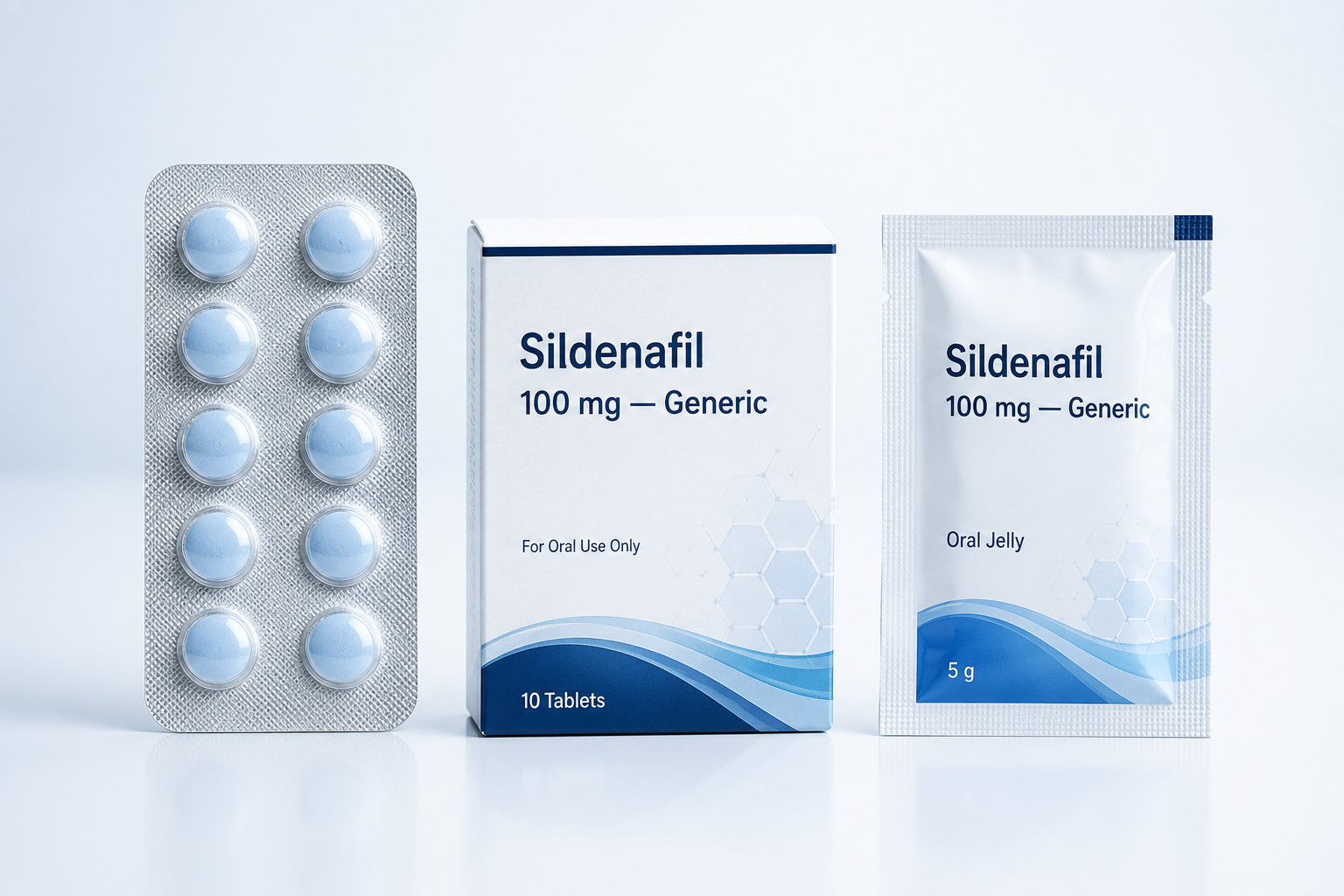
India produces a significant share of the world’s generic pharmaceuticals due to its large, highly developed manufacturing sector and long‑established export infrastructure. Many facilities operate under GMP certification, ensuring controlled production environments, stable dosage, and consistent batch quality. This regulatory foundation supports the global reliability of Indian sildenafil generics.
Indian brands offer a wide variety of formulations, including standard tablets, soft tabs, and oral jelly, each designed to meet different patient preferences and clinical contexts. Strengths typically range from 25 mg to 200 mg, reflecting diverse therapeutic needs and manufacturing capabilities. The presentation on this page remains fully neutral, focusing on safety, formulation differences, and manufacturing standards rather than commercial promotion. For pricing‑related considerations, see Price Factors.
India’s pharmaceutical sector is one of the largest and most established in the world, supported by extensive manufacturing infrastructure, competitive production costs, and decades of experience in generic drug development. These factors enable India to produce a significant share of global sildenafil generics, supplying both domestic and international markets with consistent output.
Many major Indian factories operate under GMP certification, ensuring controlled environments, validated equipment, and strict quality‑control protocols. This regulatory foundation supports stable dosage, batch consistency, and reliable formulation. Export‑oriented manufacturers also follow additional international compliance standards, allowing their products to meet requirements in multiple regions.
India’s dominance is therefore rooted in scale, regulatory alignment, and manufacturing expertise rather than commercial positioning. For safety considerations related to online sourcing, see Online Safety.
Indian pharmaceutical manufacturing operates under a combination of national and international standards designed to ensure product quality, stability, and safety. GMP (Good Manufacturing Practice) is the core regulatory framework, requiring strict hygiene, validated processes, and routine quality checks. ISO‑certified facilities follow additional quality‑management systems that reinforce consistency across batches.
Export‑focused manufacturers often hold further certifications to comply with international regulatory requirements. These may include region‑specific approvals, documentation standards, and enhanced testing protocols. However, manufacturing standards can vary between factories due to differences in equipment, process validation, and regulatory oversight. This variability makes certification status a key indicator of reliability.
Understanding these standards helps users evaluate the safety and consistency of Indian sildenafil brands. For broader safety principles, visit Online Safety.
| Standard | Meaning | Impact |
|---|---|---|
| GMP | Good Manufacturing Practice | Stable dosage |
| ISO | Quality management | Consistent batches |
| Export certification | International compliance | Higher reliability |
India hosts a wide range of sildenafil brands produced by established pharmaceutical companies with extensive experience in generic manufacturing. These brands differ in formulation types, dosage ranges, and export presence, reflecting the diversity of India’s production capabilities. Tablets remain the most common form, while soft tabs and oral jelly offer alternative options for users seeking faster dissolution or non‑tablet formats. Strengths typically span 25–200 mg depending on the manufacturer and intended use.
The table below provides a neutral overview of leading Indian sildenafil brands, including manufacturers, available forms, dosage ranges, and notable characteristics. This information is intended for clinical context only and does not promote any specific product. For more details on form‑specific differences, see Soft Tabs and Oral Jelly.
| Brand | Manufacturer | Forms | Strengths | Notes |
|---|---|---|---|---|
| Cenforce | Centurion Laboratories | Tablets, Soft Tabs | 25–200 mg | Largest export brand |
| Fildena | Fortune Healthcare | Tablets, CT (chewable) | 25–150 mg | Wide form variety |
| Kamagra | Ajanta Pharma | Tablets, Oral Jelly | 50–100 mg | Popular jelly form |
| Manforce | Mankind Pharma | Tablets | 50–100 mg | Strong domestic presence |
| Suhagra | Cipla | Tablets | 25–100 mg | High reputation |
| Zenegra | Alkem | Tablets | 50–100 mg | Stable formulation |
Indian manufacturers produce a wider range of sildenafil forms than many other regions due to their large-scale infrastructure and specialization in generic diversification. Standard tablets remain the most common format, offering stable dosage and long shelf‑life. Soft tabs provide faster dissolution and are favored by users seeking quicker onset.
Oral jelly is another widely produced form, valued for ease of administration and rapid absorption. Sublingual variants are also available from select manufacturers, offering accelerated onset through mucosal absorption. This diversity reflects India’s ability to support multiple formulation technologies within a single manufacturing ecosystem.
Form differences can influence onset, absorption, and food interactions. For related clinical context, see Onset & Duration and Food Interactions.
Indian sildenafil manufacturers offer one of the widest dosage ranges globally, reflecting both domestic demand and extensive export activity. Standard strengths such as 100 mg are universally available, forming the baseline for most clinical contexts. Lower strengths like 25 mg and 50 mg are produced by nearly all brands to accommodate users requiring milder therapeutic effect or gradual titration.
India also manufactures higher strengths, including 150 mg and 200 mg, which are less common in US/EU markets. These elevated doses exist due to India’s long-standing generic production ecosystem, where manufacturers develop expanded ranges to meet diverse regional requirements. Availability varies between brands depending on factory capability, formulation stability, and export certification.
The table below summarizes the typical strength distribution across major Indian sildenafil brands, highlighting neutral clinical characteristics rather than commercial positioning.
| Strength | Availability | Notes |
|---|---|---|
| 25 mg | Most brands | Low‑dose option |
| 50 mg | All brands | Standard dose |
| 100 mg | All brands | High‑dose baseline |
| 150 mg | Some brands | Intermediate high dose |
| 200 mg | Few brands | Very high dose |
Price variation among Indian sildenafil brands is influenced by several manufacturing and logistical factors. Differences in production standards play a major role: GMP‑certified factories typically maintain higher operational costs due to strict quality‑control protocols, validated equipment, and routine batch testing. These requirements can affect final pricing even within the same dosage category.
Formulation type also impacts cost. Tablets are generally the most economical to produce, while soft tabs and oral jelly require additional processing steps, specialized machinery, and more complex stability testing. Higher strengths may also be priced differently due to increased raw‑material requirements and stricter potency validation.
Logistics and export pathways further contribute to price variability. Brands with strong international distribution networks may have higher compliance expenses, while domestic‑focused manufacturers often operate with lower overhead. For a deeper breakdown of pricing variables, see Price Factors.
Safety across Indian sildenafil brands depends primarily on manufacturing standards and product integrity. GMP‑certified facilities follow strict protocols that ensure stable dosage, controlled environments, and validated production processes. This reduces the risk of inconsistent potency or contamination, which can occur in non‑regulated settings.
Packaging quality is another essential factor. Clear batch numbers, accurate labeling, and intact blisters help verify authenticity and confirm that the product has been stored correctly. The expiry date is equally important, as degraded medication may lose potency or increase the likelihood of adverse reactions.
Understanding these safety elements helps distinguish reliable products from low‑quality alternatives. For broader safety principles, see Online Safety, and for information on potential reactions, visit Side Effects.
Indian and non‑Indian sildenafil brands differ in manufacturing scale, pricing structures, and available formulations. Indian manufacturers typically offer a wider range of forms—including tablets, soft tabs, and oral jelly—due to their extensive generic‑production infrastructure. In contrast, US/EU brands usually focus on standard tablet formulations with narrower dosage ranges.
Price differences often reflect production costs and regulatory environments. Indian brands benefit from large‑scale manufacturing and competitive raw‑material sourcing, while non‑Indian brands may operate under stricter regional compliance frameworks that increase overall cost. However, higher price does not inherently indicate superior quality; GMP certification remains the primary safety marker across all regions.
Manufacturing standards can vary between factories regardless of country, making certification status more relevant than geographic origin. For a neutral comparison between specific brands, see Cenforce vs Viagra.